30 by 30 Workout Modifier Calculator
Calculate your recommended starting reps for each exercise based on your fitness level to avoid burnout
Why Modify?
The article mentions that many people quit because they push too hard. This calculator helps you start at a sustainable level while still building strength.
Your Recommended Starting Reps
Push-ups
Squats
Plank Holds
Glute Bridges
Mountain Climbers
Total daily reps:
Tip: Start with these numbers and gradually increase when you can complete all reps with good form.
The 30 by 30 workout isn’t some fancy gym trend with fancy equipment or expensive apps. It’s just 30 days of doing 30 reps of five basic bodyweight exercises - every single day. No rest days. No excuses. If you’ve ever tried to get fit and quit after a week because it felt too hard or too boring, this might be the reset you need.
What Exactly Is the 30 by 30 Workout?
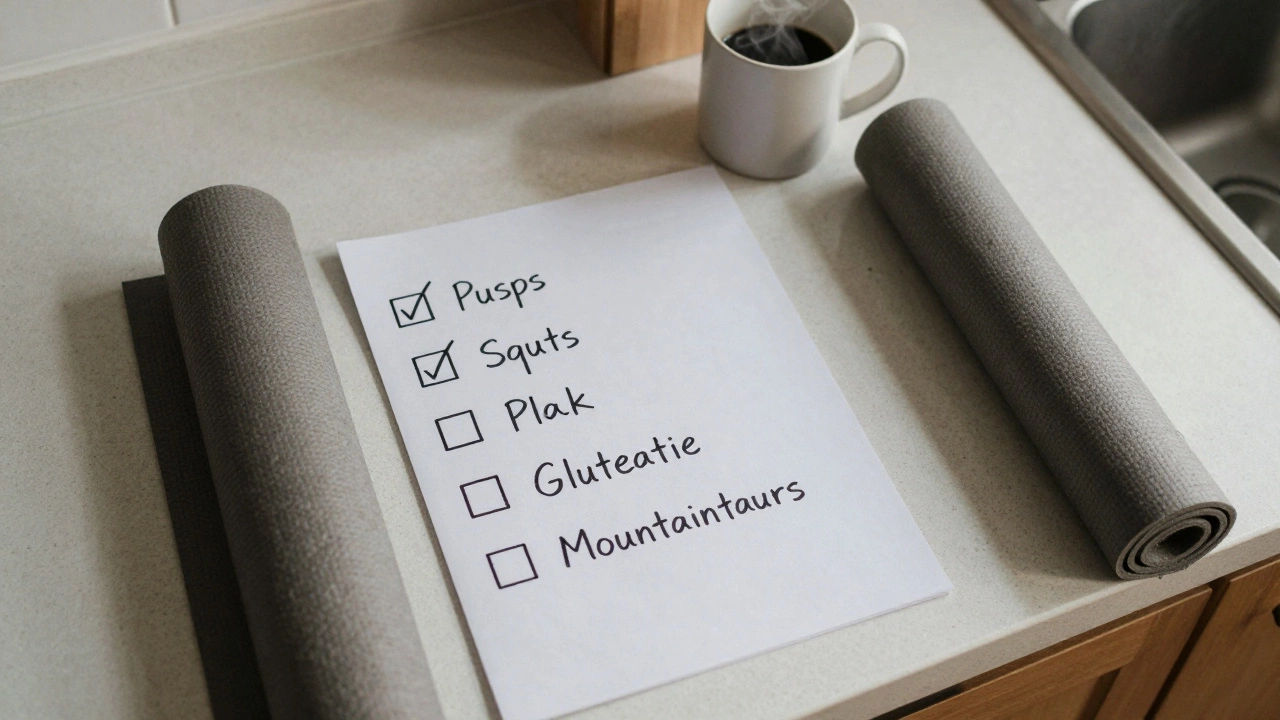
The 30 by 30 workout is exactly what it sounds like: 30 repetitions of five exercises, done daily for 30 days. That’s 150 reps per day, or 4,500 reps total over the month. The exercises are:
- Push-ups
- Squats
- Plank holds
- Glute bridges
- Mountain climbers
You don’t need a gym. You don’t need weights. You just need a mat or a carpeted floor. Most people do it first thing in the morning, but you can squeeze it in anytime - during a lunch break, after dinner, even while watching TV. The key is consistency, not intensity.
This routine was popularized by fitness coaches who noticed how many people got stuck in the cycle of starting strong and fading fast. The 30 by 30 format removes decision fatigue. There’s no need to pick workouts, track sets, or count calories. Just show up. Do the reps. Move on.
Why These Five Exercises?
Each movement targets a major muscle group and works together to build functional strength - the kind you use walking up stairs, lifting groceries, or playing with kids.
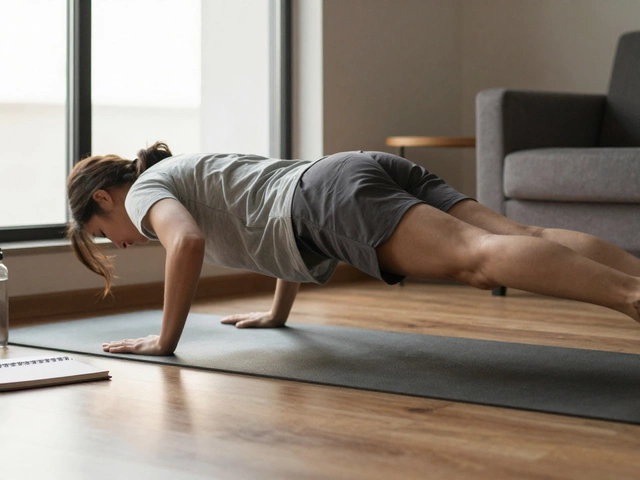
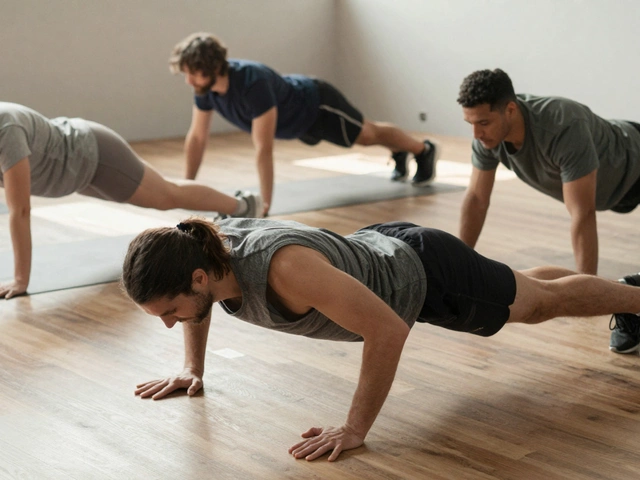
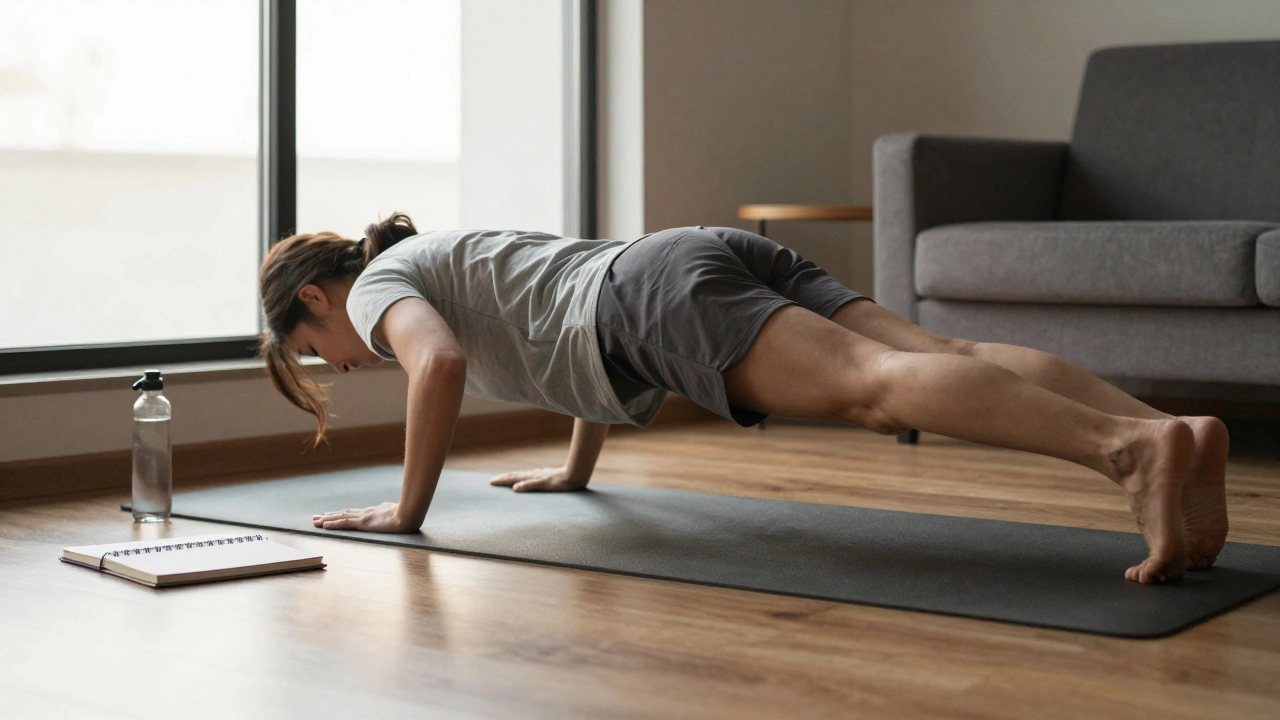
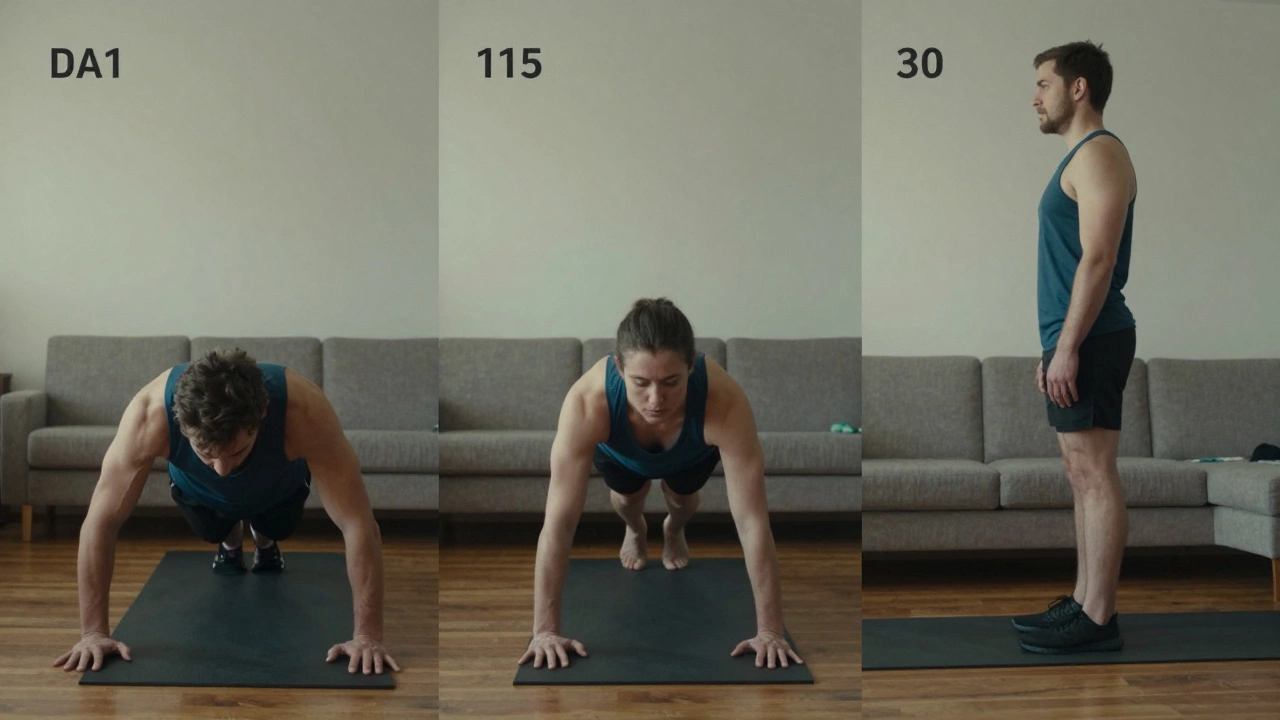
- Push-ups work your chest, shoulders, triceps, and core. They’re a full upper-body builder.
- Squats hit your quads, hamstrings, glutes, and lower back. They’re the foundation of leg strength.
- Plank holds train your core to stay tight - not just for abs, but for better posture and spine stability.
- Glute bridges activate your glutes and hamstrings, which most people underuse from sitting all day.
- Mountain climbers combine cardio with core work. They get your heart rate up without needing to run.
These aren’t random picks. They’re the five most effective bodyweight movements for full-body conditioning. No single exercise here is optional. Skipping one means missing a key piece of the puzzle.
How to Actually Do It (Without Burning Out)
Doing 30 reps of each exercise back-to-back might sound exhausting - and it can be, especially at first. But here’s the trick: you don’t have to do them all at once.
Break them into smaller sets. For example:
- Do 3 sets of 10 push-ups, rest 30 seconds
- Do 3 sets of 10 squats, rest 30 seconds
- Hold a plank for 30 seconds, rest 20 seconds
- Do 3 sets of 10 glute bridges, rest 20 seconds
- Do 3 sets of 10 mountain climbers, rest 30 seconds
That’s it. No timers, no apps needed. Just count your reps and rest when you need to. As you get stronger, you’ll naturally reduce rest time. By day 15, many people start doing them in one smooth circuit.
It’s okay to modify. If full push-ups are too hard, do them on your knees. If you can’t hold a plank for 30 seconds, start with 15. Progress isn’t about perfection - it’s about showing up.
What Happens After 30 Days?
People who finish the 30 by 30 workout report real changes - not just in how they look, but in how they feel.
- More energy: Even people who were tired all day say they wake up feeling sharper.
- Better posture: Planks and glute bridges fix slouching. People stand taller without even trying.
- Stronger core: Clothes fit differently. Waistlines shrink without dieting.
- Improved endurance: Walking up stairs doesn’t leave you winded anymore.
- Confidence boost: Finishing something hard - without quitting - changes how you see yourself.
A 2023 study from the University of Florida tracked 212 people who completed the 30 by 30 challenge. On average, participants increased their push-up capacity by 42%, squat depth improved by 31%, and plank hold time doubled. Those who stuck with it beyond 30 days kept gaining strength - not because they changed the routine, but because they kept doing it.
Who Should Try This?
This isn’t for everyone - but it’s for more people than you think.
Great for:
- Beginners who feel overwhelmed by complex routines
- People who hate gyms or don’t have time for long workouts
- Anyone recovering from injury (with doctor’s approval)
- Parents, teachers, or office workers who need a simple way to move more
Not ideal for:
- People with recent joint injuries (knees, shoulders, lower back) - modify or pause
- Those with severe cardiovascular issues - talk to a doctor first
- People looking for rapid weight loss - this builds strength, not calorie burn
If you’re unsure, start with 10 reps per exercise and see how your body responds. You can always scale up.
Common Mistakes People Make
Most people who quit do so not because it’s too hard - but because they do it wrong.
- Skipping form for speed: Rushing through reps leads to bad habits. Slow down. Control the movement.
- Doing it only on weekends: Consistency matters more than volume. One day a week won’t cut it.
- Comparing yourself to others: Someone else might do 50 push-ups in a row. You do 10 with good form. That’s progress.
- Expecting instant results: The changes are subtle at first. You’ll notice them around day 10-12, not day 3.
Keep a simple journal. Write down how you felt each day - not how many reps you did. Did you sleep better? Did you feel less stiff? Those are the real wins.
What Comes After 30 Days?
After 30 days, you’ve built a habit. That’s the real victory.
Some people stop. Others keep going. Here are three paths:
- Repeat the 30 by 30: Do it again. You’ll be stronger, and you’ll notice new improvements.
- Upgrade the reps: Go to 40 reps per exercise. Or add a 6th movement like lunges or wall sits.
- Move to a structured program: Now that you’ve built discipline, try a 5-day strength plan or a running schedule. You’ll be ready.
The goal isn’t to finish the 30 by 30. The goal is to prove to yourself that you can stick with something hard - and that you don’t need a perfect plan to get results.
Final Thoughts
The 30 by 30 workout isn’t about getting ripped or running a marathon. It’s about proving to yourself that you can show up, day after day, even when you don’t feel like it. That’s the kind of discipline that changes lives - not just bodies.
Start tomorrow. Do 30 push-ups. Then 30 squats. Then the rest. Don’t think about the whole month. Just do today’s 150 reps. That’s all you need.
Can I do the 30 by 30 workout if I’m overweight?
Yes. The workout is scalable. If full push-ups are too hard, do them on your knees. If squats hurt your knees, hold onto a chair for support. The goal isn’t to look a certain way - it’s to move better. Progress comes from consistency, not perfection.
Do I need to rest on weekends?
No. The 30 by 30 is designed to be done every day, including weekends. Rest days aren’t required because the intensity is low and the movements are bodyweight-based. Your muscles recover faster than you think. If you feel sore, slow down the pace - don’t skip.
Will this help me lose weight?
Not directly. The 30 by 30 builds strength and endurance, not calorie burn. You’ll likely lose fat if you combine it with better eating habits, but the workout alone won’t create a big calorie deficit. Think of it as a foundation - not a weight-loss tool.
How long should each workout take?
About 15 to 20 minutes when you’re starting out. As you get faster and reduce rest time, you can cut it to 10 minutes. It’s short enough to fit into any schedule.
What if I miss a day?
Don’t quit. Just pick up where you left off. Missing one day doesn’t ruin the challenge - quitting does. The point is to build the habit of showing up, not to be perfect.
Can I do this if I’m over 50?
Absolutely. Many people over 50 use this routine to regain mobility and strength. Modify the movements as needed - use chairs for support, reduce reps if needed, and focus on control over speed. Strength training becomes even more important as you age.