
Personal Workout Plan Builder
Select your primary objective for the next 8-12 weeks:
Build size and definition with moderate weights and higher reps
Lift heavier loads with compound movements and lower reps
Reduce body fat with resistance training and cardio combination
Improve overall fitness, sleep quality, and longevity
Weekly Schedule
Exercise Selection
Sets, Reps & Rest Guidelines
Plan Summary
- Goal:
- Frequency:
- Split Type:
- Equipment:
- Duration:
Walking into a gym and staring at rows of machines often feels like walking into a library where you don't speak the language. You see people lifting heavy things, running on treadmills, and doing strange bodyweight movements, but you have no idea what they are doing or why. The biggest mistake beginners make is copying someone else's routine without understanding their own goals. That leads to burnout, injury, or quitting after two weeks because nothing changed.
Creating your own workout plan doesn't require a degree in kinesiology or a personal trainer's salary. It requires honesty about your current ability, clarity on what you want to achieve, and a simple structure that fits your life. If you can answer three questions-what do I want, how much time do I have, and what equipment do I own-you already have enough information to start building an effective workout plan.
Define Your Primary Goal First
Before you pick up a single dumbbell, you need to know what 'success' looks like for you. Most people say they want to 'get fit,' which is too vague to build a plan around. 'Fit' means different things to a marathon runner than it does to a powerlifter. You need to narrow this down to one primary objective for the next 8 to 12 weeks.
Here are the four most common categories:
- Hypertrophy (Muscle Growth): You want to look bigger and more defined. This requires resistance training with moderate weights and higher repetitions.
- Strength: You want to lift heavier loads. This focuses on compound movements like squats and deadlifts with lower repetitions.
- Fat Loss: You want to reduce body fat percentage. This combines resistance training with cardiovascular exercise and a calorie deficit.
- General Health & Endurance: You want to feel better, sleep better, and improve longevity. This involves full-body movement and consistent cardio.
Pick one. Trying to maximize muscle growth while trying to run marathons and lose fat simultaneously usually results in mediocre progress in all areas. Once you pick your goal, every exercise you choose will serve that purpose.
Determine Your Available Time and Frequency
The best workout plan is the one you actually stick to. If you think you'll go to the gym five days a week but only have realistic energy for three, you're setting yourself up for failure. Be brutally honest about your schedule. Look at your calendar for the next month. How many days do you have open blocks of 45 to 60 minutes?
Frequency matters more than intensity when starting out. Consistency builds the habit; intensity builds the result. Here is how to structure your frequency based on your available days:
| Days Per Week | Recommended Split | Best For |
|---|---|---|
| 2 Days | Full Body (A/B) | Beginners, busy schedules |
| 3 Days | Full Body or Upper/Lower/Full | Most beginners, general health |
| 4 Days | Upper/Lower Split | Muscle growth, strength |
| 5+ Days | Push/Pull/Legs or Bro Split | Advanced lifters, high volume |
If you can only train twice a week, do two full-body sessions. Hit every major muscle group each time. If you can train four times, split your body into upper and lower halves so each part gets adequate rest. Rest is not laziness; it's when your muscles repair and grow stronger.
Select Your Exercises: The Core Movements
You don't need fifty different exercises. You need five to seven fundamental movement patterns that recruit multiple muscle groups at once. These are called compound movements. They give you the most bang for your buck because they work more muscles in less time.
Every solid workout plan includes variations of these six patterns:
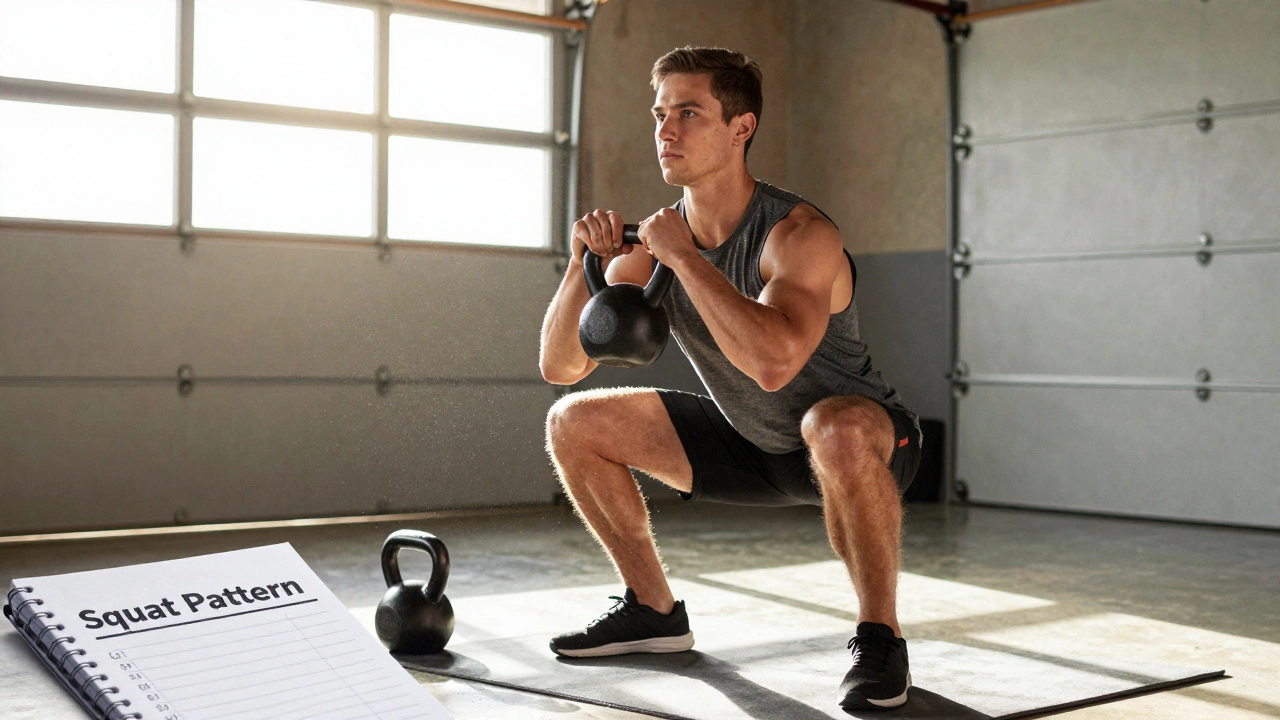
- Squat Pattern: Works quads, glutes, and core. Examples: Goblet squats, back squats, lunges.
- Hinge Pattern: Works hamstrings and glutes. Examples: Deadlifts, kettlebell swings, hip thrusts.
- Push Pattern (Vertical): Works shoulders and triceps. Examples: Overhead press, push-ups.
- Push Pattern (Horizontal): Works chest and triceps. Examples: Bench press, floor presses.
- Pull Pattern (Vertical): Works lats and biceps. Examples: Pull-ups, lat pulldowns.
- Pull Pattern (Horizontal): Works mid-back and rear delts. Examples: Rows, face pulls.
For a beginner, choosing one exercise from each category per session is plenty. If you are working out at home with limited equipment, substitute barbell movements with dumbbells or bodyweight variations. A push-up is just as effective as a bench press if done with proper form and progressive overload.
Understand Sets, Reps, and Rest
This is where most people get confused. What does '3 sets of 10 reps' actually mean? And how long should you rest between them? These variables dictate whether you build strength, endurance, or size.
A set is a continuous number of repetitions. A rep is one complete motion of an exercise. If you squat down and stand up ten times without stopping, that is one set of ten reps.
Rest periods are crucial. Short rests (30-60 seconds) increase metabolic stress and are good for endurance or fat loss. Long rests (2-3 minutes) allow your nervous system to recover, enabling you to lift heavier weights for strength and power.
| Reps per Set | Weight Load | Primary Benefit | Rest Period |
|---|---|---|---|
| 1-5 | Heavy (85%+ 1RM) | Strength | 2-3 minutes |
| 6-12 | Moderate (65-80% 1RM) | Muscle Growth (Hypertrophy) | 60-90 seconds |
| 15+ | Light (<65% 1RM) | Endurance | 30-60 seconds |
For general fitness and muscle tone, aim for 3 to 4 sets of 8 to 12 repetitions with 60 to 90 seconds of rest. This sweet spot balances safety, efficiency, and results. Don't go to absolute failure on every set. Leave one or two reps 'in the tank.' This preserves your joints and allows you to train consistently over months, not just weeks.
Implement Progressive Overload
This is the secret sauce that separates a random collection of exercises from a true fitness routine. Progressive overload means gradually increasing the demand placed on your body. If you lift the same weight for the same reps every week for six months, your body will adapt and stop changing. You must challenge it.
You can apply progressive overload in several ways:
- Increase Weight: Add 2.5kg to the bar if you completed all sets and reps with good form.
- Increase Reps: If you did 8 reps last week, try for 9 this week with the same weight.
- Improve Form: Slow down the eccentric (lowering) phase. Control the movement rather than swinging.
- Decrease Rest: Reduce rest time between sets to increase intensity.
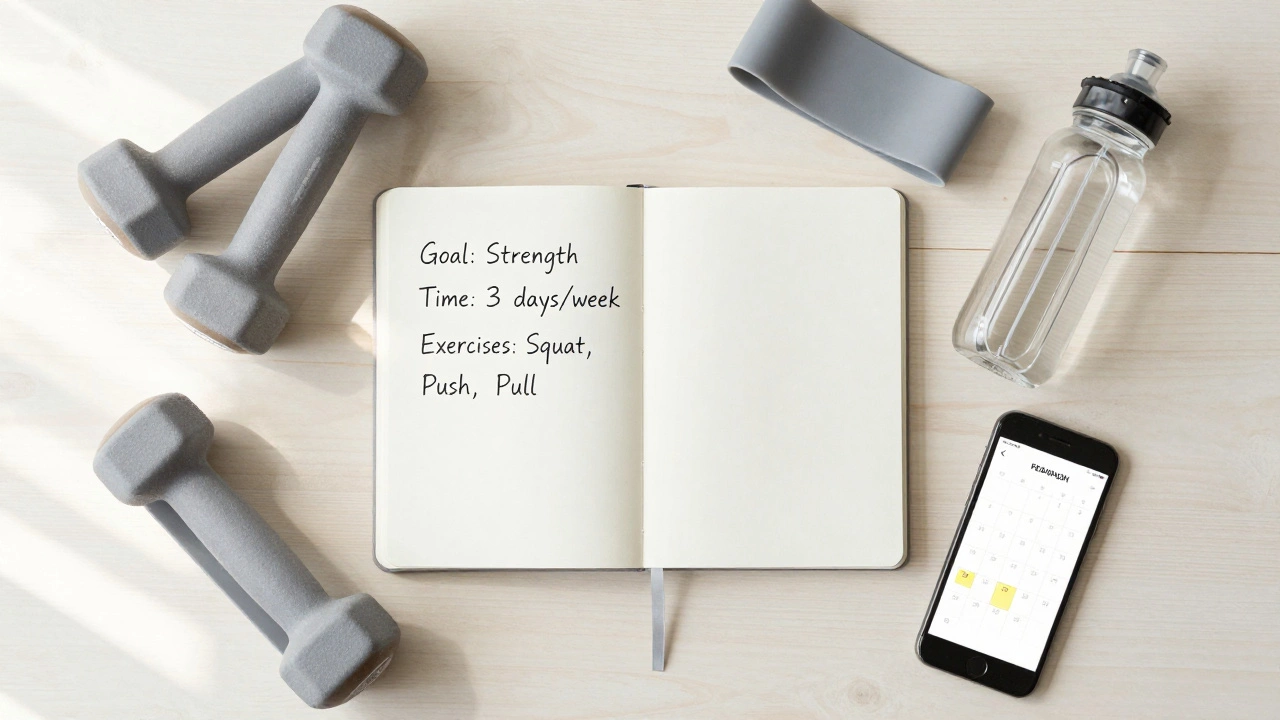
Track your workouts. Use a notebook or a phone app. Write down the exercise, weight, sets, and reps. When you return to the gym, look at what you did last time. Your only job is to beat that number slightly. This data-driven approach removes guesswork and provides tangible proof of progress.
Structure Your Weekly Schedule
Now we put it all together. Let's create a sample 3-day full-body plan for someone with a busy schedule who wants to build general strength and muscle.
Monday: Full Body A
- Goblet Squat: 3 sets x 10 reps
- Bench Press (or Push-ups): 3 sets x 8-12 reps
- Bent-over Row: 3 sets x 10 reps
- Plank: 3 sets x 45 seconds
Wednesday: Full Body B
- Romanian Deadlift: 3 sets x 10 reps
- Overhead Press: 3 sets x 8-12 reps
- Pull-ups (or Lat Pulldown): 3 sets x 8-12 reps
- Lunges: 3 sets x 10 reps per leg
Friday: Full Body C
- Front Squat (or Leg Press): 3 sets x 10 reps
- Incline Dumbbell Press: 3 sets x 10 reps
- Cable Face Pulls: 3 sets x 15 reps
- Core Circuit: 3 rounds
Tuesday, Thursday, Saturday, and Sunday are rest or active recovery days. Active recovery means light walking, stretching, or yoga. It keeps blood flowing without stressing the central nervous system. Listen to your body. If you are sore, take an extra rest day. Soreness is normal; pain is not.
Common Mistakes to Avoid
Even with a perfect plan, small errors can derail your progress. Watch out for these pitfalls:
Ego Lifting: Using too much weight with poor form. This leads to injury and reinforces bad movement patterns. Master the technique before adding load. Film yourself if you can't find a mirror.
Inconsistency: Skipping weeks because life got busy. Life will always be busy. Build a minimum viable workout. If you only have 20 minutes, do half the planned sets. Something is always better than nothing.
Neglecting Nutrition: You cannot out-train a bad diet. Muscle repair requires protein. Energy requires carbohydrates and fats. Aim for 1.6 to 2.2 grams of protein per kilogram of body weight daily. Hydration also plays a huge role in performance and recovery.
Ignoring Sleep: Growth hormone is released during deep sleep. If you sleep five hours a night, your recovery capacity drops significantly. Prioritize 7 to 9 hours of quality sleep as part of your training protocol.
How long does it take to see results from a new workout plan?
Neurological adaptations (getting stronger due to better nerve signaling) happen within 2 to 4 weeks. Visible muscle changes typically take 8 to 12 weeks of consistent training and proper nutrition. Don't judge your progress by the mirror alone; track your strength numbers and how your clothes fit.
Can I change my workout plan every week?
No. Changing exercises too frequently prevents you from mastering form and tracking progressive overload. Stick to a program for at least 8 to 12 weeks. After that period, you can introduce new variations to prevent plateaus and keep things interesting.
Is it better to work out in the morning or evening?
The best time is the time you will actually do it. Some people perform better in the evening when body temperature is higher, while others prefer mornings to ensure consistency. Test both for a few weeks and see which fits your energy levels and schedule best.
Do I need supplements to build muscle?
Supplements are optional. Whole foods should provide the majority of your nutrients. Whey protein powder can be convenient for hitting protein targets, and creatine monohydrate is one of the most researched supplements for improving strength and muscle mass. However, they are not magic pills without a solid training and diet foundation.
What should I do if I miss a workout?
Don't panic and don't try to double up the next day. Just resume your schedule the following day. Missing one workout has negligible impact on long-term progress. Consistency over months matters far more than perfection over a single week.