Work-Life Alignment Calculator
Work-life balance isn't about a perfect 50/50 split; it's about alignment and satisfaction. Take this quick assessment to see where you stand.
Your Result
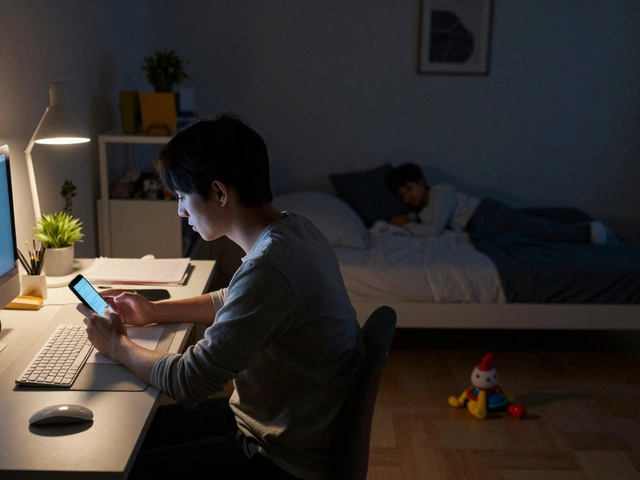
It’s 7:30 PM. You’re sitting at your desk, the glow of your monitor illuminating a half-finished report, while your dinner sits cold on the counter. Your phone buzzes with a message from your partner asking if you want to watch that new show together. You hesitate. Do you reply? Do you close the laptop? Or do you just ignore everything and keep typing until the task is done?
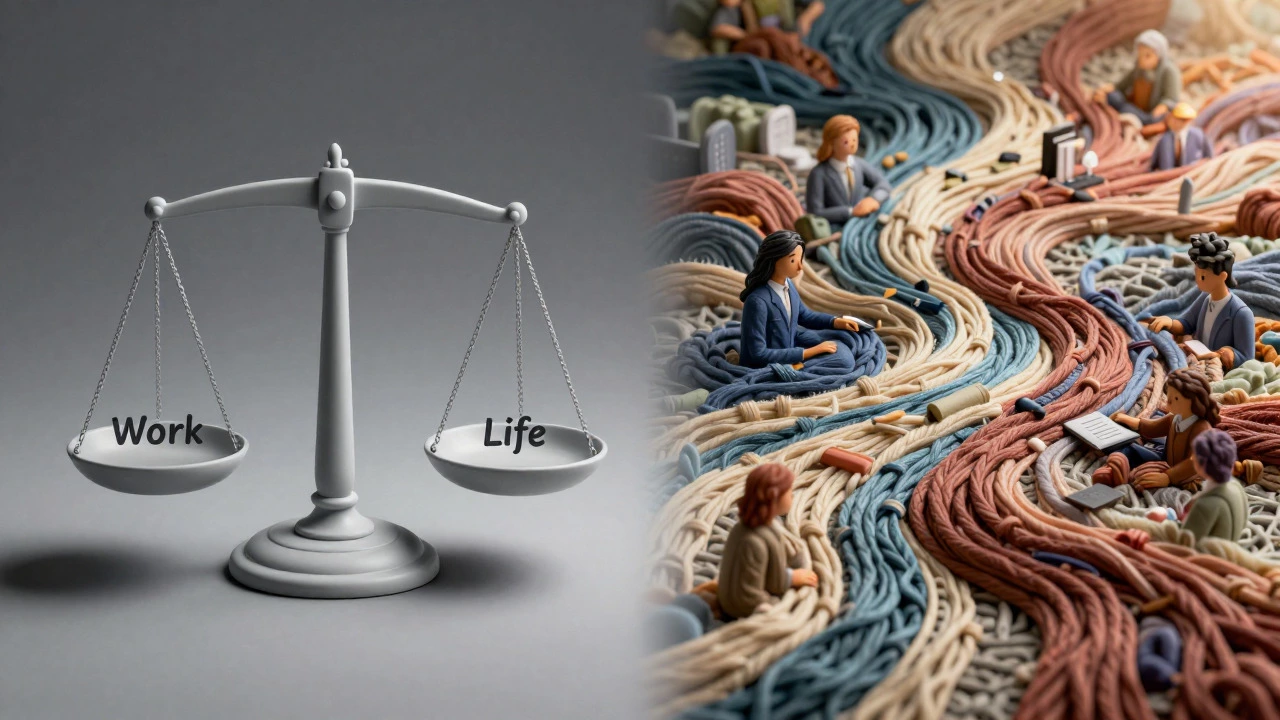
If this scene feels familiar, you aren’t alone. We’ve been sold a myth for decades: that work-life balance is a static state where you spend exactly 40 hours working and 40 hours living, perfectly divided like slices of a pie. But in reality, that definition is obsolete. It doesn’t account for parents, entrepreneurs, remote workers, or anyone whose life doesn’t fit into a rigid nine-to-five box.
So, what exactly is work-life balance today? It isn’t about equal time. It’s about alignment. It’s the ability to switch between roles without guilt, stress, or resentment. It’s knowing when to push hard and when to step back so you don’t burn out. In this guide, we’ll strip away the corporate jargon and look at how to actually build a sustainable rhythm that works for you, not just your employer.
The Myth of the Perfect Split
We need to start by killing the idea of the "50/50 split." For most people, achieving perfect equality between professional and personal time is impossible-and frankly, unnecessary. If you have three kids, a mortgage, and a demanding job, spending exactly the same amount of energy on each is unrealistic.
Instead of balance, think of it as integration. This concept suggests that work and life can overlap and support each other rather than compete. Maybe you take a walk during lunch to clear your head (life supporting work). Maybe you answer one urgent email after dinner so you can sleep peacefully (work supporting life).
The goal isn’t symmetry; it’s satisfaction. Are you present when you are working? Are you present when you are home? If you are physically at the dinner table but mentally drafting a presentation, you have neither work nor life-you just have anxiety.
Why Does It Matter Now More Than Ever?
In 2019, the World Health Organization classified burnout as an occupational phenomenon. This wasn’t just a semantic change; it was a warning sign. Burnout isn’t just being tired. It’s emotional exhaustion, cynicism toward your job, and a feeling of ineffectiveness. When you lose your work-life boundaries, burnout becomes inevitable.
Consider the data. Studies consistently show that employees who feel they have control over their schedules are more productive, not less. The old belief that longer hours equal better output is flawed. After a certain point-usually around 50 hours a week-productivity plummets due to fatigue and errors. By protecting your off-hours, you are actually protecting your professional performance.
Moreover, the rise of remote work has blurred the lines even further. Without the physical commute to signal "end of day," many people find themselves working longer hours than before. The office is now everywhere, which means you must create artificial boundaries to survive.
Signs You’ve Lost Your Balance
How do you know if you are out of sync? It’s rarely dramatic. It usually starts small. Here are five concrete signs that your scale is tipping too far toward work:
- Physical symptoms: Chronic headaches, stomach issues, or insomnia. Your body keeps score even when your mind tries to ignore it.
- Irritability: You snap at loved ones over minor things because your patience tank is empty.
- Guilt: You feel guilty when you are working (because you should be with family) and guilty when you are relaxing (because you should be working).
- Loss of hobbies: You haven’t picked up a book, cooked a meal, or seen a friend in months because there’s "no time."
- Dread: You feel a physical sense of dread on Sunday evenings or before logging on for the day.
If you nodded along to two or more of these, it’s time to recalibrate. Ignoring them leads to deeper issues, including depression and cardiovascular problems.
Strategies to Reclaim Your Time
Fixing work-life balance isn’t about buying a planner or downloading an app. It requires behavioral changes and boundary setting. Here are practical steps you can take starting today.
1. Define Your Non-Negotiables
Most people try to do everything and end up doing nothing well. Pick three non-negotiable values for your personal life. Maybe it’s dinner with the family, an hour of exercise, or reading before bed. Write them down. Then, schedule them in your calendar just like you would a client meeting. If it’s not on the calendar, it won’t happen.
2. Create Transition Rituals
Since we lack the commute, we need a ritual to signal the shift from "worker" to "human." This could be a 10-minute walk, changing out of work clothes immediately, or listening to a specific playlist. This psychological cue tells your brain that the workday is over, helping you disconnect fully.
3. Master the Art of Saying No
This is the hardest skill to learn. Every "yes" to a low-priority task is a "no" to your peace of mind. Evaluate requests based on impact. Does this meeting need you? Can this email wait until tomorrow? Learn to say, "I’d love to help, but my plate is full right now. Let’s revisit this next quarter." Most reasonable managers will respect honesty over false availability.
4. Audit Your Digital Boundaries
Turn off non-essential notifications after hours. Use features like "Do Not Disturb" on your phone and computer. If you use Slack or Teams, set your status to "Away" automatically at 6 PM. Out of sight really does become out of mind. If your team expects instant responses at 8 PM, that’s a cultural issue that needs addressing, but controlling your own access is the first step.
| Work Style | Pros | Cons | Best For |
|---|---|---|---|
| Rigid 9-5 | Clear separation of time | d>Little flexibility for personal needsPeople who thrive on structure | |
| Remote/Hybrid | Flexibility, no commute | Blurred boundaries, isolation | Self-disciplined individuals |
| Results-Only | Total freedom over schedule | Pressure to always deliver, potential overwork | High performers, freelancers |
The Role of Technology
Technology is both the enemy and the ally of work-life balance. On one hand, smartphones tether us to work 24/7. On the other, tools like time-tracking software and automation platforms can reduce busywork.
Use technology to automate repetitive tasks. If you spend hours every week formatting reports, look for software that can do it in minutes. Reclaim those hours for deep work or rest. However, be wary of "digital clutter." Too many apps can fragment your attention. Stick to a few essential tools and master them.
Also, consider using website blockers during focus times and relaxation times. Apps like Freedom or Cold Turkey can prevent you from doom-scrolling social media or checking email when you should be resting.

Cultural Shifts and Employer Responsibility
While individual effort matters, systemic change is crucial. Companies that promote "always-on" culture are losing talent. In 2025, we saw a surge in legislation across Europe and parts of Asia granting employees the right to disconnect. This legal framework prevents employers from penalizing staff for not answering emails outside working hours.
As an employee, you can advocate for this. Ask your manager about flexible hours. Propose trial periods for remote work. Show data that proves your productivity remains high when you have autonomy. Leaders are increasingly recognizing that retention is cheaper than recruitment, and happy employees stay longer.
Maintaining Balance Long-Term
Work-life balance isn’t a one-time fix. Life changes. You might get promoted, have a child, or care for an aging parent. Your needs will shift. Check in with yourself monthly. Ask: "Am I enjoying my life? Am I proud of my work?" If the answer is no to either, adjust your strategy.
Remember, perfection is the enemy of progress. Some weeks will be heavy on work. Others will be heavy on life. That’s okay. As long as you have the awareness to notice the imbalance and the agency to correct it, you are winning.
Is work-life balance possible for parents?
Yes, but it looks different. Parents often experience "seasons" where one area demands more energy. The key is communication with partners and employers, and lowering expectations for household perfection. Focus on quality time rather than quantity.
How do I handle a boss who expects 24/7 availability?
Set gradual boundaries. Start by responding to late-night emails only in the morning unless it’s a true emergency. Communicate your preferred response times clearly. If the culture is toxic and unchangeable, consider looking for a healthier workplace.
Does remote work improve work-life balance?
It can, but it requires discipline. Without a commute, you save time, but you may also work longer hours. Success depends on creating physical and mental boundaries between your workspace and living space.
What is the difference between work-life balance and integration?
Balance implies a strict separation, like two sides of a scale. Integration acknowledges that work and life can blend seamlessly, allowing you to move fluidly between roles based on immediate needs and priorities.
Can hobbies help with work-life balance?
Absolutely. Hobbies provide a mental break from work-related stress. Engaging in activities you enjoy boosts dopamine and creativity, which can actually enhance your performance when you return to work.